

Custom Solutions
Custom solutions for the way your business actually works
Portals, internal tools, and the integrations that join what you already run. Scoped to your process rather than to what a product happens to allow.
We are proud to work with these companies


















Fit
Who this is for.
The process runs on a spreadsheet, a WhatsApp group and somebody’s memory, and it has stopped scaling.
You pay for software that does most of the job, and staff do the rest by hand every day.
Two systems you depend on do not talk, so the same record gets typed into both.
Scope
What arrives.
Applications and portals
- Dashboards, admin systems and internal tools
- Secure client and customer portals, on your own domain
- Document submission, with upload and storage
- Role-based access — staff, customers and admins each see their own view
- Staged access, where the next step unlocks once the last one is done
Process and data
- Staged pipelines, with a status on every record
- Booking and scheduling that obeys your real constraints
- Custom CRM and admin systems, replacing the spreadsheet they grew out of
- Automated documents — contracts, certificates, invoices
- Reporting and scheduled exports, to an inbox or a sheet
Joining what you already run
- Integrations between CRM, accounts, stock and delivery
- Third-party APIs — payments, logistics, compliance portals
- Custom code inside a platform that cannot do it natively
- Google Sheets, Make.com and n8n, where those are the right tool
- Data migration out of spreadsheets and systems you are leaving
Working together
How it runs.
A paid discovery
We map the process as it actually runs, including the parts nobody has written down and the exceptions everyone works around. The output is a written scope with the build quoted against it — and it is yours whether or not we are the ones who build it.
Scope, then a fixed quote
Nothing is priced before discovery, because a number given before anyone has seen the process is a guess. What gets built, what does not, and what it costs are all settled in writing first.
Built in stages
Delivered in working pieces rather than one reveal at the end, so you are using part of it while the rest is still being built — and can change your mind while changing it is still cheap.
Handover
Every account in your name, the credentials yours, and a walkthrough with the people who will use it. What was built and how it is wired is written down, not held in our heads.
What we need from you
- An hour or two with somebody who actually runs the process day to day
- Access to the systems it has to talk to, or the person who can grant it
- The real edge cases — the awkward ones are the reason this is being built
- Someone who can settle a scope question without a committee
Where the quote comes from
The step nobody else has.
Most of what a business does, every business does — take the order, take the money, get it out of the door. Software you can buy is built for those. Then there is the step that is yours, and it is the one nothing off the shelf has an opinion about.
A courier company
Take the bookingCheck the driver is still compliantAssign a vanCollectDeliver
Licence, insurance and police check all expire on different dates. Miss one and the job is not late, it is illegal.
A clinic
Book the slotTake a depositRoute it by who is on callSend the reminderSee the patient
Which consultant, which room, which day. That rule is different at every practice, and no booking product ships with yours in it.
A supplier
Take the orderPrice it by weight and distancePickPackDispatch
Freight is not a flat rate. Get it wrong on every order and the margin leaves with the goods.
A rental business
EnquiryQuoteHold the stock before the payment clearsSign the contractHand it over
Two customers can book the same item in the same minute. An off-the-shelf cart has no opinion about which of them gets it.
Cost
What it depends on.
- How much of the process it covers
- One step automated is a different piece of work from an end-to-end system that a customer, your staff and an administrator all use.
- How many systems it has to talk to
- Each integration is its own piece of work, and a well-documented API is a fraction of the cost of one that is not.
- Who logs in, and what each of them can see
- One shared login is straightforward. Several roles with different permissions is the part that takes the time, and it is usually the part that matters.
- What has to come across
- Moving years of records out of spreadsheets or a system you are leaving is real work, and it is worth doing properly once.
- Project, or an ongoing arrangement
- Some of this is built, handed over and finished. Some of it keeps changing as the business does, and that runs as a retainer.
Every project is quoted against its own scope. Quoted after discovery, never before it. Anyone who prices a custom build off a phone call is guessing, and the guess is corrected later at your expense. Tell us what you are trying to do and you will get a number, not a range that moves later. Start that conversation.
Proof
One we built.
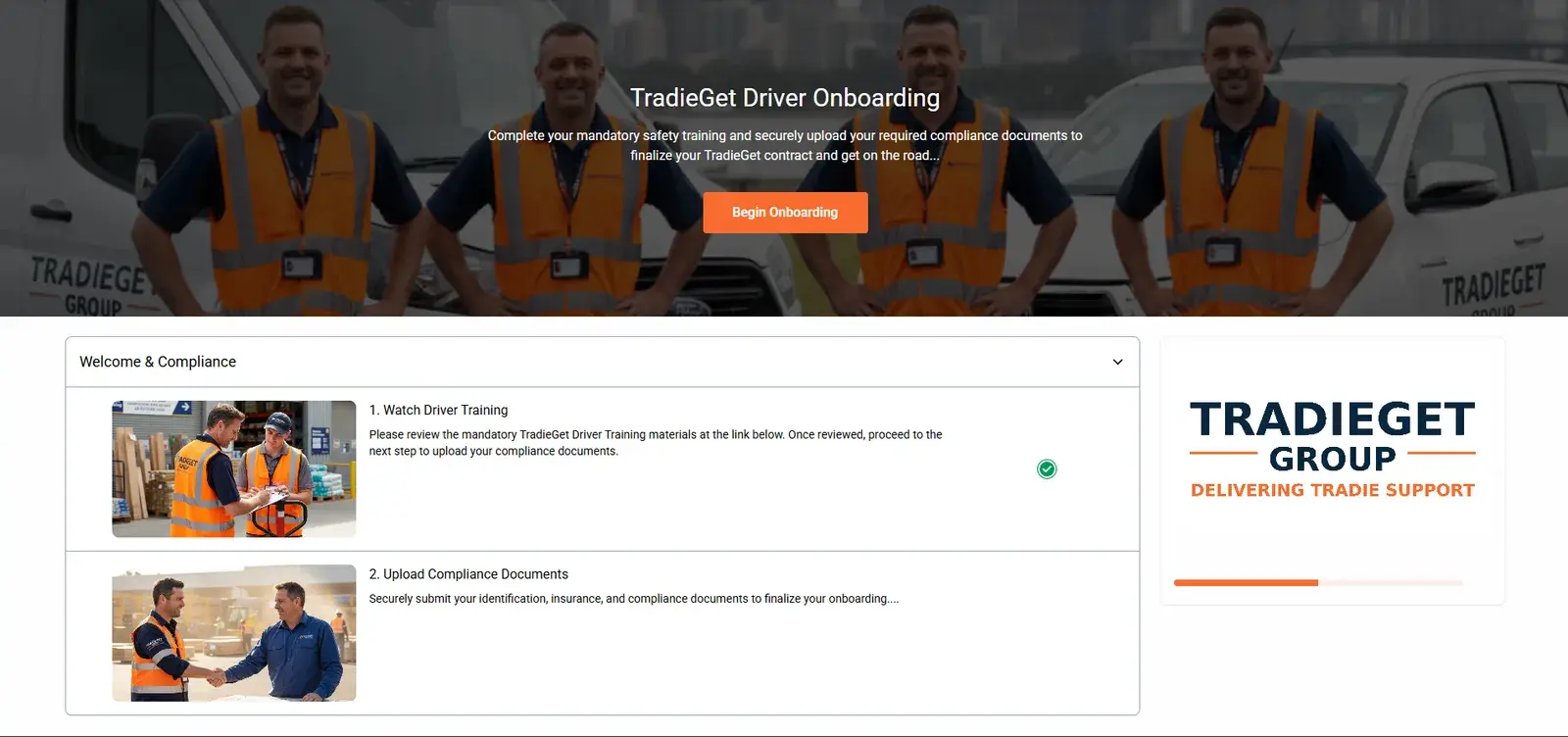
A compliance portal for a delivery company, on their own subdomain — the application, the documents, the eleven stages behind it, and the checks that run before anybody is cleared to drive.
Case studies using Custom Solutions
Questions
The ones people actually ask.
How do I know whether I need this, or just better use of what I have?
That is what discovery answers, and it is the reason it is paid rather than free — it is real work and you keep the output. Often the finding is that two products you already pay for should be talking to each other, which is a much smaller job than a build — and connecting them is work we do. You end up paying for the small job instead of the large one.
Do you build from scratch, or on top of a platform?
Whichever costs you less to own. Building on something you already run is usually faster and cheaper to maintain, and where a platform stops short, custom code goes in beside it rather than replacing the lot. From scratch is right when what you need is genuinely unlike anything you can buy — and that is a real answer sometimes, not a default.
Who owns what you build?
You do. Accounts in your name, credentials handed over, and documentation of how it is put together. If you want to take it to another developer afterwards, nothing here is designed to stop you.
What happens when it breaks, or the business changes?
Defects in what we built are fixed. Beyond that, some clients take a maintenance retainer because the process keeps moving and the software has to move with it, and some take the handover and run it themselves. Both are fine; what is quoted depends on which you want.
Can you work with our existing developer or IT team?
Yes. Sometimes the useful version of this is us building one piece and documenting the interface, rather than taking the whole thing on.
Is this a project or a retainer?
Either, and it depends on the work rather than on what we would prefer to sell. A portal that does one job is a project with an end. A system that grows with the business is an ongoing arrangement, and it gets quoted as one.
Next step
Tell us the step that keeps going wrong
Not the whole roadmap — the one part of the process that costs you time every week, or the two systems somebody is re-typing between. That is enough to say whether this is a build, an integration, or something you should not be paying for at all.